
Human Sweat: the New Frontier of Perfumery
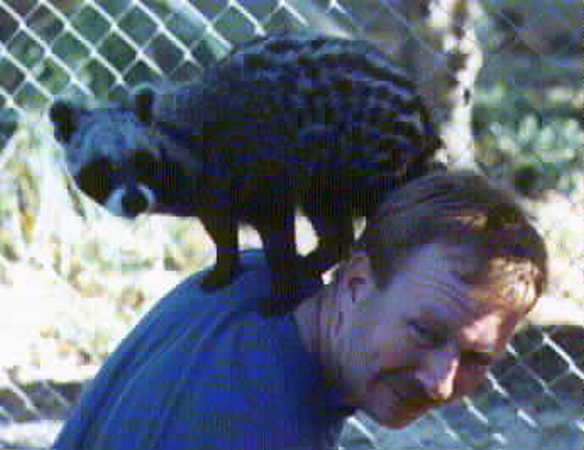
Civet easily becomes a pet, but keep your nose away from its behind part
Whoever smelled pure Civet for the first time has wondered how such an odor could enter into a perfume bottle. My first impression was the smell of rotten tooth.
It takes some training to be able to understand Civet perfume, one has to overcome the social olfactory programming that make us classify straight away this odor among stenches.
An infinitesimal dose of Civet can double the longevity of short lived perfumes, and although being in amount so little as to be subliminal, it also add to fragrances a different olfactory dimension, the animal one, and our instinct recognizes it immediately.
This is the reason why the public often prefers the scents that contains civet or other perfumery pheromones over scents who do not.
Human sweat can be a very fascinating smell to a perfumer. A professional perfumer must approach smells with an unprejudiced nose, or must at least be able to recognize the origin of his liking or not certain smells, and thus be able to evaluate them with an objectivity not given to the general public.
Moreover, a perfumer is always very attentive to the reactions of people to smells, because his aim is to build scents that people will like (and buy).
Human sweat tells what a person eats, his condition of health and also about his sexual life. Most of these things we perceive with our animal instinct and they are not intellectualized, but our behavior towards a person is very much conditioned by these information.
I once red the post of a pervert perfumer specialized into making aphrodisiac perfumes, where he was contemplating using his own sweat in a fragrance. I hope for his customers that he did not do it in one of the fragrances that he sells, but I invite every one of you to do this revolutionary perfume experience for himself in a very simple way.
My life with natural fragrances as a traveller in some of the hottest uncivilized spots of the earth, without hotels or much water had forced me to resolve the armpit smell problem with what I had ready at hand, that is my natural essences and perfumes. I made an armpit perfume and called it “Dance with wolves”.
The result is astonishing, much better than any deodorant and than any perfume as well.
Armpit smell disappears as such and blends into the perfume which becomes much more rich and persistent. The essential oils that compose the perfume have an antiseptic effect that cuts drastically the bacterial fauna which is responsible for the typical armpit scent (see research on human pheromones).
You can see that people react very positively to such a perfume, specially the opposite sex.
You have both a deodorant product and a personal aphrodisiac perfume.
Your own sweat blended with “Dance with wolves” is probably the best sustainable alternative to animal scents in perfumery, and a much nicer way to experiment a “human pheromone perfume” that the one imagined by the pervert perfumer.
Find a natural perfumer, let him make your own custom perfume, spray it under your armpits where your natural pheromones are, and the smell of sweat will be transformed into a musky fragrance that will attract compliments.
give me your feed back, like Valeria whose comment is below.
You can also try: Dance with Wolves
Comments:
By Valeria
Valéria
What a great post on how to take advantage of your own sweat pheromones to enhance and personalize a natural perfume. Ever since I had to write a paper on this topic during my aromatherapy certification, I’ve been trying to figure out how to leverage that information in natural perfumery and here is the answer. I also appreciated your linked-to post on human pheromones.
It’s fascinating to me that the nasal cavity is the only place in the body where the environment comes into direct contact with the central nervous system. While other sensory info comes in through the thalamus, the sense of smell comes directly to the brain via the olfactory epithelium – one of the oldest parts of the brain. Before we consciously process a smell, our bodies have already reacted to it. I appreciated your post on human pheromones because there’s not enough reference in natural perfumery to that 2007 study published in the Journal of Neuroscience which identified the chemical in male sweat – androstadienone – that when smelled alters hormone levels in women. This is, after all, a natural process. And while the mainstream perfume industry appears to be trying to capitalize on this chemical reaction via synthesis of pseudo-androstadienone, your post provides a really straightforward and imaginative path for the natural perfume industry to do even better, and without millions of dollars in R&D.
Don’t get me wrong, I’m still waiting with much interest for scientists to figure out the whys of the olfactory process – especially where pheromones are concerned – so we can understand how to better leverage chemical constituents in our essential oils. But in the end it seems like the role of natural scents is something we as mammals have always understood at the cellular level. Our ancestors had far more familiarity (and less discomfort) with the relationship between bodily odors and bodily response. Mandy Aftel in her book Essence and Alchemy points out that the use of body odor as an aphrodisiac is recorded in the ancient literature of nearly all languages. Clothing scented with a suitor’s perspiration was “smuggled into the proximity of the desired sexual partner, and sweat also played an important role in the preparation of elixirs… During Shakespeare’s time, a woman in love would place a peeled apple in her armpit to saturate it with her scent and then present it to her beloved as a token of her desire.”
Again, thanks for the great post!
Heathe







Leave a Reply
Want to join the discussion?Feel free to contribute!